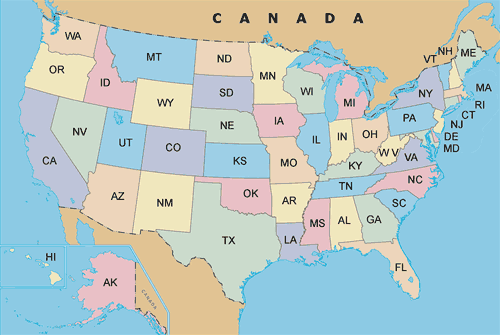
National Facts
United States of America


Bald Eagle

The Star-Spangled Banner

Rose
America the Beautiful
A Photo Journey

Donald J. Trump (2017-2021, 2025-present)
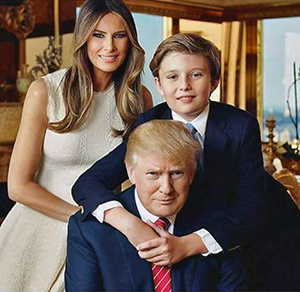

Barbara & George H.W. Bush, Laura & George W. Bush, Bill & Hillary Clinton, Jimmy & Rosalynn Carter



God shed His grace on thee





President
"I know that the Lord is always on the side of the right. But it is my constant anxiety and prayer that I and this nation should be on the Lord's side."
Did you know?
Fun Facts & History
The first confirmed European landing in present-day United States territory was by Christopher Columbus, who visited Puerto Rico on November 19, 1493.
Florida was home to the earliest European colonies on the mainland; they died out except for St. Augustine (founded by Pedro Menéndez de Avilés in 1565).
A hundred or so French fur traders set up small outposts in the Great Lakes region. A few thousand Spanish settled in New Mexico and California.
The first successful English settlement was at Jamestown, Virginia, in 1607, followed in 1620 by the Pilgrims' landing at Plymouth, Massachusetts, then the arrival of the colony of Massachusetts Bay, started by the Puritans.
In 1609 the Dutch settled New York and in 1617, they settled in New Jersey.
In 1638, the Swedes founded New Sweden (part of which became Delaware, New Jersey, and Pennsylvania).
Throughout the 17th and early 18th centuries, England established new colonies, took over Dutch colonies, and split others.
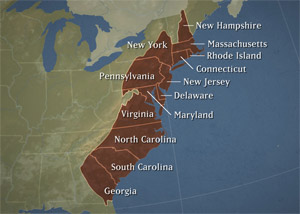
With the division of the Carolinas in 1729, and the colonization of Georgia in 1732, the 13 British colonies that became the United States of America in 1776 were established and all had active local and colonial governments with elections open to most free men.
The nation was founded by thirteen colonies declaring their independence from Great Britain on July 4, 1776 and ratifying the Articles of Confederation, on March 1, 1781 uniting the states under a weak federal government. It adopted the current constitution on September 17, 1787.
From 1803 to 1848, the size of the new nation nearly tripled as settlers (many embracing the concept of Manifest Destiny) pushed beyond national boundaries even before the Louisiana Purchase.
As new territories were being incorporated, the nation was divided over the issue of states' rights, the role of the federal government, and the expansion of slavery. The Northern states abolished slavery in 1804 and were opposed to the expansion of slavery whereas the Southern states' economy was dependent on slave labor. These issues led to the Civil War, following the secession of the Southern states to form the Confederate States of America after the 1860 election of Abraham Lincoln.
The 1865 Union victory in the Civil War ended slavery and settled the question of whether a state had the right to secede. The event was a major turning point in American history and resulted in an increase in federal power.
The United States is the world's oldest surviving federation. Its government relies on representative democracy through a congressional system under a set of powers specified by its Constitution.
The federal government comprises three branches, which are designed to check and balance one another's powers:
• Legislative: The Congress, made up of the Senate and the House of Representatives, which makes federal law, declares war, approves treaties and has powers of impeachment.
• Executive: The President, who administers and enforces federal law, can veto bills, and is Commander in Chief of the military.
• Judiciary: The Supreme Court and lower federal courts, whose judges are appointed by the President with Senate approval, which interpret laws and their validity under the Constitution and can overturn laws they deem unconstitutional.
The United States is the world's third largest country by total area after Russia and Canada.
With the collapse of the Soviet Union in 1991, the USA became the world's sole remaining superpower and continues to exert dominant economic, political, cultural, and military influence around the globe.
The Americas were also known as Columbia, after Columbus, prompting the name District of Columbia for the land set aside as the U.S. capital.
The phrase "united States of America" was first used officially in the Declaration of Independence (July 4, 1776). On November 15, 1777, the Second Continental Congress adopted the Articles of Confederation, the first of which stated "The Stile of this Confederacy shall be 'The United States of America.'" The name was originally proposed by Thomas Paine.
THE GREAT SEAL: The design of the first seal of the President of the United States of America was approved on June 20, 1782. It was designed by Benjamin Franklin, John Adams and Thomas Jefferson at the request of the Continental Congress.
The seal pictures an American bald eagle holding a ribbon in its beak; the ribbon has the motto of the USA, "E PLURIBUS UNUM," meaning "Out of many, one." The eagle is clutching an olive branch (with 13 olives and 13 leaves) in one foot (symbolizing peace) and 13 arrows in the other (the 13 stands for the original 13 colonies and the arrows symbolize the acceptance of the need to go to war to protect the country). A shield is in front of the eagle; the shield has 13 red and white stripes (representing the original 13 colonies) with a blue bar above it (it symbolizes the uniting of the 13 colonies and represents congress). Above the eagle are rays, a circle of clouds, and 13 white stars.
One early American flag that pictures a coiled rattlesnake. The rattlesnake was used in early American history as a symbol of resistance against British rule.
Benjamin Franklin thought that the wild turkey should be the national bird of the USA.
The Pledge of Allegiance: "I Pledge Allegiance to the flag of the United States of America and to the Republic for which it stands, one Nation under God, indivisible, with liberty and justice for all."
National Flower: "Americans have always loved the flowers with which God decorates our land. More often than any other flower, we hold the rose dear as the symbol of life and love and devotion, of beauty and eternity. For the love of man and woman, for the love of mankind and God, for the love of country, Americans who would speak the language of the heart do so with a rose... The American people have long held a special place in their hearts for roses. Let us continue to cherish them, to honor the love and devotion they represent, and to bestow them on all we love just as God has bestowed them on us.... NOW, THEREFORE, I, RONALD REAGAN, President of the United States of America, do hereby proclaim the rose as the National Floral Emblem of the United States of America. (November 20, 1986)
On every Fourth of July, children who are descendants of signers of the Declaration of Independence symbolically tap the Liberty Bell 13 times while bells across the nation also ring 13 times in honor of the patriots from the original 13 states.
With over 3.8 million square miles and over 325 million people, the United States is the third largest country by both total area and population. With a gross domestic product (GDP) of over $18 trillion, the U.S. has the largest national economy in the world.
The earliest known use of the name America is attributed to the German cartographer Martin Waldseemüller who created a globe and a large map showing North and South America in 1507.
The United States contains examples of nearly every global climate. The climate is temperate in most areas, tropical in Hawaii and southern Florida, polar in Alaska, semiarid in the Great Plains, deserts in the Southwest, Mediterranean in coastal California and arid in the Great Basin. Its generous climate contributed to the country's rise as a world power.
The U.S. has over 17,000 identified native plant and tree species, including 5,000 just in California (which is home to the tallest, the most massive, and the oldest trees in the world).
The U.S. has over 400 species of mammal, 700 species of bird, 500 species of reptile and amphibian, and 90,000 species of insect.
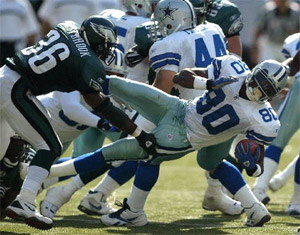
Professional sports in the U.S. is big business and has the world's highest paid athletes. The "Big Four" sports are baseball, American football, ice hockey, and basketball. Baseball is referred to as "the national pastime"; however, since the early 1990s, football has been the most popular sport in the U.S.
In 1872, the world's first National Park was established at Yellowstone by a bill signed into law by President Ulysses S. Grant. Another 59 national parks and hundreds of other federally managed parks and forests have since been designated. Wilderness areas have been established to ensure long-term protection of pristine habitats.
Rock, pop, soul, hip hop, country, blues, and jazz are among America's most internationally renowned genres of music.
The birth and development of cinema largely took place in the United States. Hollywood, California is the movie capital of the world.
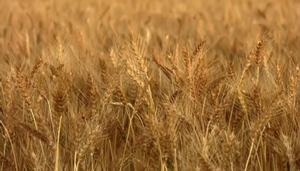
The USA is a top producer of corn, soy beans, rice, and wheat, with the Great Plains labeled as the "breadbasket of the world" for its tremendous agricultural output
The American Dream is the idea that, through hard work, courage, and self-determination, regardless of social class, a person can gain a better life.
Religion has traditionally played a large role in American society; many of the original European colonists came to America for religious reasons. Religion still has a major influence on American politics and culture.
Rev. Billy Graham (1918-2018) preached Christianity to live audiences of over 210 million people in more than 185 countries and territories. Graham also reached hundreds of millions more through television, video, film, and webcasts. He was a spiritual adviser to multiple U.S. presidents and was number 7 on Gallup's list of admired people for the 20th century.
The U.S. was the most instrumental nation in the development of the Internet, developing its predecessor, Arpanet. U.S. businesses control most of its infrastructure.
America's Ethnic Roots -- 2010 Census: German 15.2%, Irish 10.8%, African 8.8%, English 8.7%, American 7.2%, Mexican 6.5%, Italian 5.6%, Scandinavian 3.7%, Polish 3.2%, French 3%, Native American 2.8%
Religion in the USA -- 2014 survey: Protestant 46.5%, Roman Catholic 20.8%, Jewish 1.9%, Mormon 1.6%, other Christian 0.9%, Muslim 0.9%, Jehovah's Witness 0.8%, Buddhist 0.7%, Hindu 0.7%, other 1.8%, unaffiliated 23.4%
The U.S. has a large tourist industry, ranking third in the world.
Following World War II, a shift occurred with the decline of Paris as the world's art center and the emergence of New York as the center of contemporary fine art.
The United Nations assigned an Education Index of 0.890 to the United States, ranking it number 5 in the world. The USA has a basic literacy rate of 98% to 99%. 30% of the population has earned a bachelor's degree or higher, and 81% have graduated high school.
Largest U.S. Cities: New York City (NY), Los Angeles (CA), Chicago (IL), Houston (TX), Philadelphia (PA), Phoenix (AZ), San Antonio (TX), San Diego (CA), Dallas (TX), San Jose (CA)
On the morning of September 11, 2001, nineteen Islamic terrorists affiliated with al-Qaeda hijacked four commercial passenger jet airliners. The hijackers crashed two of the airliners into the World Trade Center Twin Towers, resulting in the collapse of both buildings. A third airliner was crashed into the Pentagon near Washington D.C. Passengers and members of the flight crew on the fourth aircraft (United Airlines Flight 93) attempted to retake control of their plane from the hijackers -- that plane crashed into a field in rural Pennsylvania. About 3,000 people were killed in all incidents. This attack on U.S. soil plunged America into an ongoing global war on terror.